SteerAct

Few-shot temporal steering for robot action models

SteerAct: Unlocking Action Models through Few-Shot Temporal Steering

One temporal descriptor. One feature per task. Frozen model weights.

A shared descriptor of feature dynamics links offline feature selection with online decisions about when and how to steer.

Overview

Paper overview

Abstract

Improving pretrained robot action models at test time from only a few rollouts remains challenging. Activation steering offers a lightweight approach by modifying feature activations while keeping model weights fixed. However, effective steering requires identifying which features to modify and determining the timing and strength of modification.

We introduce SteerAct, a few-shot temporal steering framework that uses a shared temporal descriptor of sparse-feature dynamics for offline feature selection and online control. A pretrained sparse autoencoder provides candidate features, and our temporal descriptor summarizes the distribution of local activation-order patterns for each feature, enabling comparisons across rollouts without requiring timestep alignment. Offline, we select a single feature per task whose temporal descriptor banks best separate successful and failed rollouts, and retain its success and failure reference banks. Online, the same descriptor guides intervention timing and the steering coefficient through comparisons with these references.

Using only 24 outcome-labeled rollouts per task, SteerAct improves task success by approximately 10% relative to unsteered models in evaluations spanning π0.5, Fast-WAM, RoboTwin 2.0, DexJoCo, and real-world manipulation, without updating action-model weights. Code and Demo can be found at: Link.

Keywords: Vision–language–action models, World–action models, Activation steering, Few-shot adaptation.
Method walkthrough

Method

One temporal descriptor, offline and online.

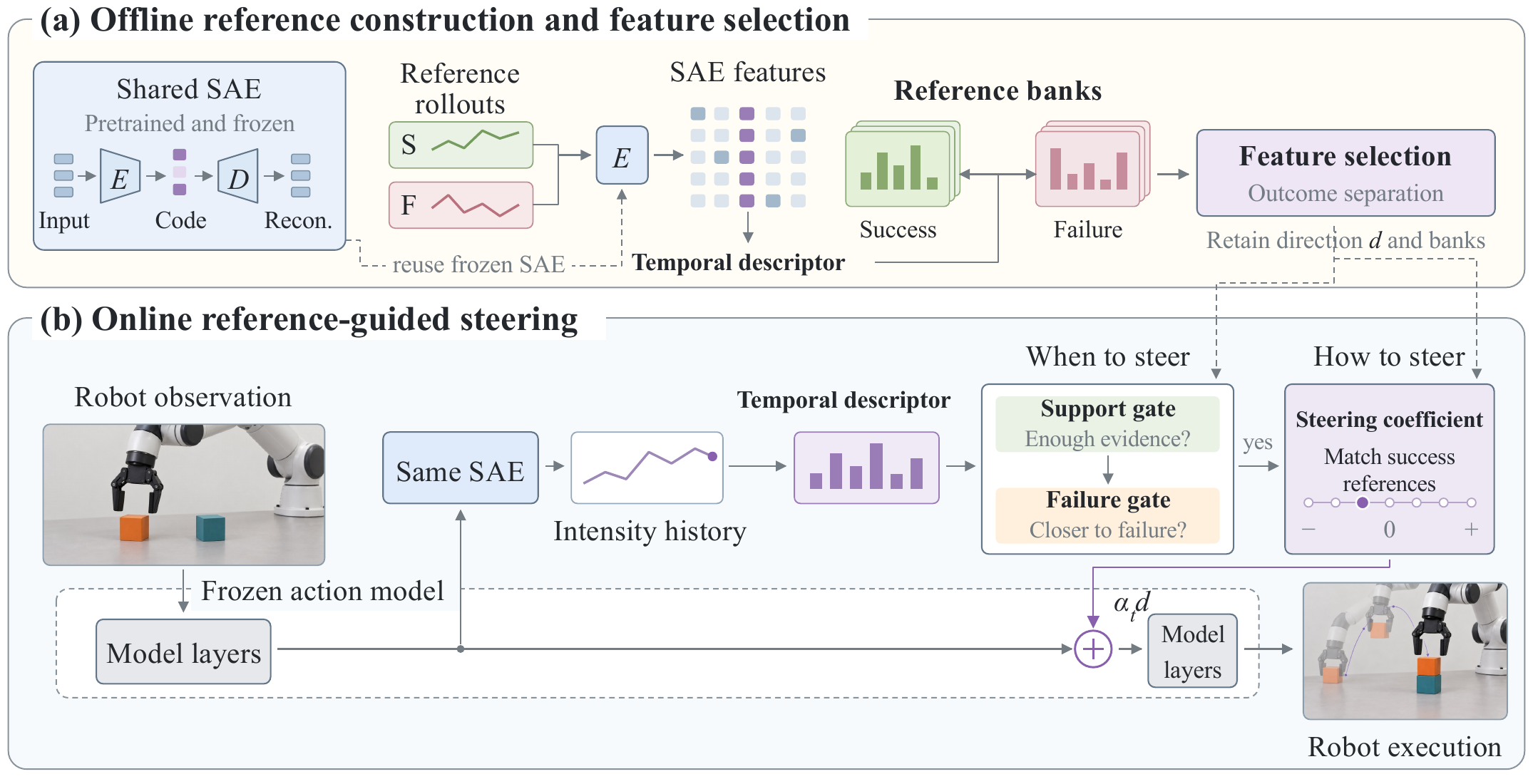
A shared sparse autoencoder (SAE) provides features and steering directions. The descriptor summarizes local activation-order patterns, comparing histories without timestep alignment.

SteerAct methodology from the paper. Offline, a frozen shared SAE exposes candidate features. Their temporal descriptors form success and failure reference banks used to select one feature. Online, the same descriptor compares its observed intensity history with these banks. The Support Gate and Failure Gate enable a bounded signed coefficient search, and the selected decoder direction modifies the frozen action model's hidden states.
The same descriptor represents complete reference rollouts, the observed execution prefix, and candidate-edited histories. The SAE and action model remain frozen during feature selection and steering.

Offline: select what to steer

Build success and failure reference banks for each candidate feature. Select the feature whose temporal patterns best separate the outcomes, accounting for variation within each bank. Retain its decoder direction and reference banks for deployment.

Online: decide when and how

The Support Gate checks whether the current history supports comparison; the Failure Gate checks whether it is closer to failure. When both gates are open, a bounded search chooses a signed coefficient whose locally predicted descriptor is closest to the success bank.

Real robot results

Same action model. Higher success.

Three physical tasks with a frozen π0.5 backbone. Rates use 30 trials per task and method; each video pair shows an example failure and success.

Simulation results

Across backbones and embodiments.

Selected examples from nine RoboTwin 2.0 gripper tasks and nine DexJoCo dexterous-hand tasks, evaluated with π0.5 and Fast-WAM. Rates use 200 held-out rollouts per task and method.

Benchmark

How it works

See when steering turns on.

Follow the feature history, two gates, and steering coefficient alongside the robot videos. 3× speed

Illustrative feature dynamics

Unsteered Open Microwave
Loading videoUnsteered Open Microwave rollout

Loading the rollout footage.

Unsteered timestep 0100 / 1200

SteerAct Open Microwave
Loading videoSteered Open Microwave rollout

Loading the rollout footage.

SteerAct timestep 0100 / 1200

0100 / 1200

Shared timeline
Both rollouts

Feature curves and the shaded reference band are illustrative, not measured activation distributions. The method compares temporal descriptors with fixed success and failure banks; the shaded band is not the bank itself.